
Piles often recur because treatments focus only on shrinking the pile mass, rather than correcting digestion, bowel habits, or internal irritation.
Ayurveda treats piles (Arsha) as a systemic disorder rooted in digestive imbalance and chronic strain, which is why it prioritises long-term correction over temporary relief.
The scenario may seem relatable to you:
You treat piles. Bleeding stops. Pain settles. Then it comes back. That cycle isn’t a failure. It’s an incomplete understanding.
Ayurveda Explains: Piles (Arsha) isn’t some surface disease
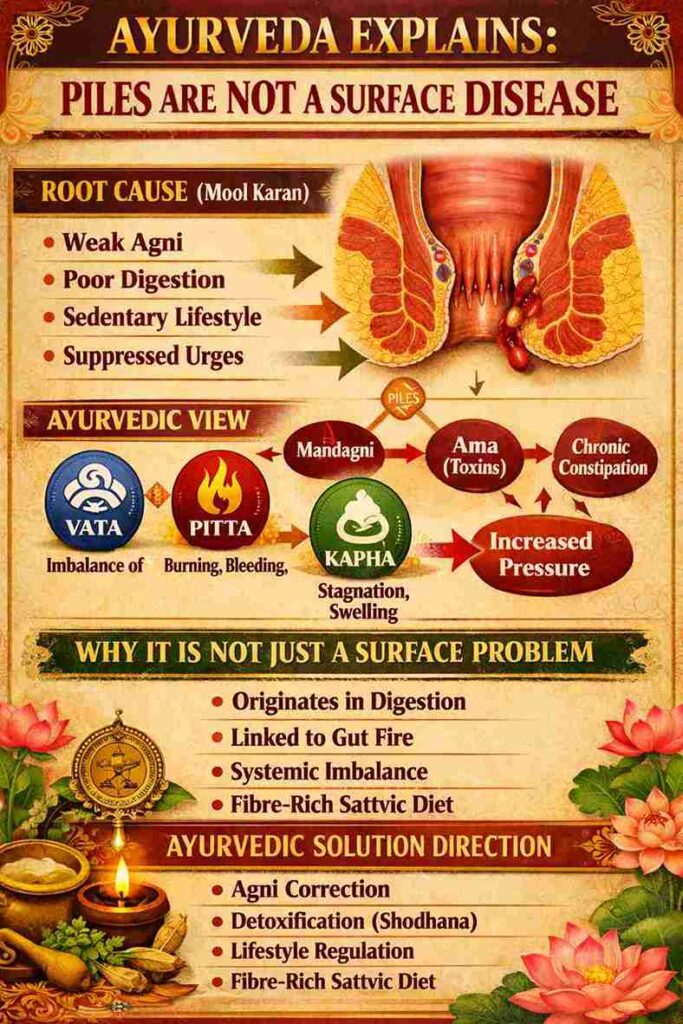
Ayurveda has warned for centuries that piles (Arsha) are not a surface disease. [Source]
They are the body’s response to long-standing digestive strain, constipation, and internal irritation. Unless the root is corrected, recurrence is not a risk. It is a certainty. This is where piles ayurvedic treatment in Kolkata changes the outcome.
Today, we discuss why piles keep returning and how ayurveda differs from quick fixes.
Let’s dive in.
Why do piles keep coming back even after treatment?
Piles keep recurring when there is weak digestion (Agni), chronic constipation, and repeated straining continue even after symptoms reduce. Treating the pile alone does not stop recurrence.
This question sits at the centre of patient frustration and is exactly why piles keep coming back.
Common recurrent causes of piles include:
- Long-term constipation and hard stools
- Straining during bowel movements
- Prolonged sitting and sedentary habits
- Inadequate fibre and hydration
- Repeated irritation of the anal tissues
Most conventional piles treatment in Kolkata focuses on reducing swelling or pain. Ayurveda asks a different question: why did the body create piles in the first place?
How does Ayurveda explain recurrent piles (Arsha)?
Ayurveda views piles (Arsha) as a digestive and elimination disorder caused by weak digestive fire, toxin build-up, and dosha imbalance, not merely a local rectal problem.
Ayurveda treats recurrence by correcting internal physiology, not by chasing symptoms.
Digestive imbalance (Agni) drives piles long-term
Weak Agni leads to incomplete digestion, hard stools, and irregular bowel movements, which increase pressure on the rectal veins and trigger recurrence.
When digestion slows, stools become dry and difficult to pass. Repeated straining damages rectal tissues, setting the stage for chronic piles.
Toxic Metabolic Waste (Ama) worsen piles
Ama is a toxic metabolic waste formed from poor digestion that causes chronic irritation, inflammation, and delayed healing in the piles.
Ama settles in sensitive tissues, preventing proper healing and causing piles to recur even after treatment.
Dosha patterns (Vata, Pitta & Kapha) are linked to recurrence
Piles recurrence depends on the dominant dosha imbalance. Vata causes constipation and pain, Pitta leads to bleeding and burning, while Kapha results in heaviness and delayed healing.
- Vata dominance: hard stools, dryness, pain
- Pitta dominance: bleeding, inflammation, burning sensation
- Kapha dominance: swelling, sluggish healing
Ayurveda treats the dominant pattern rather than applying a single solution to all patients, which is why recurrence decreases over time.
What are Kshar Karma and Kshar Sutra treatments for piles?
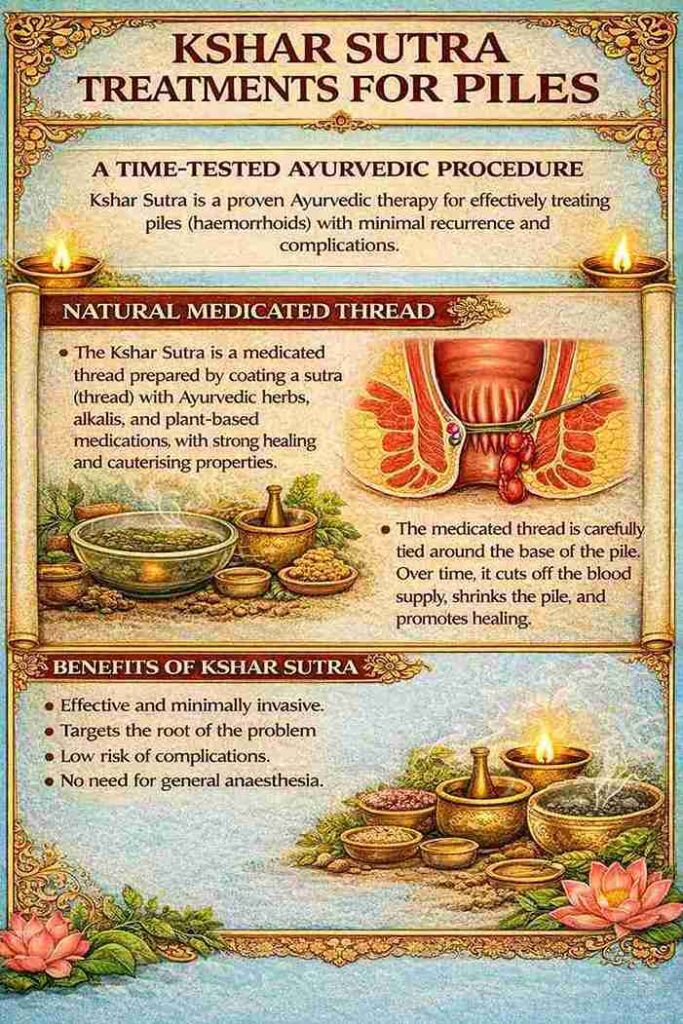
Kshar-based therapies are specialised Ayurvedic para-surgical procedures used to manage piles (Arsha). They are minimally invasive, target diseased tissue precisely, and internal correction reduces the risk of recurrence.
These therapies are chosen based on pile grade, symptoms, and digestive status, and are always performed under expert supervision.
Key features of Kshar-based therapies:
- Localised action on the pile tissue
- Minimal damage to surrounding structures
- Reduced bleeding and faster healing
- Lower recurrence when combined with internal correction
Kshar Karma: When is it used?
Kshar karma treatment for piles involves the controlled application of herbal alkaline preparations derived from medicinal plants. It is commonly indicated in early to moderate internal piles.
How Kshar Karma works:
- Chemically cauterises the pile mass
- Shrinks swollen tissue gradually
- Controls bleeding and discharge
- Preserves anal sphincter integrity
Kshar Sutra treatment for piles
Kshar sutra treatment for piles uses a medicated thread coated with herbal alkalis and healing agents, applied at the base of the pile mass.
Its therapeutic action includes:
- Gradual cutting of the pile tissue
- Simultaneous healing and fibrosis
- Reduced trauma compared to excision
- Lower risk of infection and sudden bleeding
The outcome
Clinical observations and studies report better outcomes when Kshar-based procedures are combined with digestive and lifestyle correction.
Proven benefits include:
- Lower recurrence rates
- Improved wound healing
- Reduced post-procedure complications
This integrated approach addresses both local pathology and internal causes, which is critical for long-term relief.
How does Ayurveda manage piles beyond Kshar Sutra at Ayusya Ayurveda?
At Ayusya Ayurveda, piles management extends beyond Kshar Sutra through digestive correction, classical medicines, local care, Panchakarma support, and lifestyle regulation to prevent recurrence and promote long-term healing.
Ayurveda treats piles (Arsha) as a systemic disorder. Once the local disease is addressed, internal balance and daily habits determine whether the piles heal completely or return.
How does dietary correction support the healing of piles?
Dietary correction in Ayurveda softens stools, reduces straining, and supports tissue healing in piles.
- High-fibre foods from fruits, vegetables, and whole grains
- Adequate hydration to prevent dryness and constipation
- Avoidance of spicy, fried, and processed foods that aggravate inflammation
What Ayurvedic medicines are used for pile management?
Classical Ayurvedic formulations are prescribed to regulate digestion, control bleeding, and support anorectal healing.
- Triphala for bowel regularity
- Haritaki (Terminalia chebula) for constipation relief
- Nagkesar (Mesua ferrea) supports haemostasis, reduces excessive bleeding, and calms local inflammatory response in piles.
- Arshoghni Vati, a classical formulation indicated in piles
- Aloe vera is used selectively for its soothing properties
What role do topical therapies and local care play?
Local Ayurvedic care supports wound healing and reduces irritation after piles procedures.
- Herbal ointments containing Neem and Turmeric
- Sitz baths using Triphala or Neem decoction to relieve pain and inflammation
How do lifestyle changes prevent piles recurrence of piles?
Lifestyle regulation prevents repeated strain and recurrence of piles.
- Regular physical activity
- Avoiding prolonged sitting, especially on the toilet
- Responding promptly to natural bowel urges
Is Panchakarma used alongside piles treatment?
Indeed, they are. Selected Panchakarma therapies support piles treatment by cleansing the colon, stabilising bowel function, and reducing recurrence through digestive correction.
In Ayurveda, Panchakarma is used selectively to address the internal factors contributing to piles. The focus is on restoring proper bowel movement and reducing strain rather than aggressive detoxification.
Supportive Panchakarma and allied practices include:
- Basti (medicated enema) to cleanse the colon and regulate Apana Vayu
- Yogic postures such as Malasana and Pawanmuktasana to improve bowel regularity
- Meditation and stress management to reduce stress-related digestive disruption
Together, these therapies support long-term healing and help prevent piles from recurring.
How can the recurrence be prevented long-term?
Preventing recurrence requires correcting digestion, maintaining soft stools, and following a consistent daily routine.
A practical answer to how to prevent the recurrence of piles:
- Fixed bowel routine
- Warm water intake daily
- Fibre from vegetables and seeds
- Daily walking
- Avoiding prolonged sitting
Consistency matters more than intensity.
When should you see a doctor for piles?
Persistent bleeding, severe pain, or non-reducing lumps require medical evaluation and should not be ignored.
Red flags that need attention:
- Heavy or ongoing bleeding
- Severe pain or swelling
- Lump not reducing
- Weight loss or weakness
Early consultation with a piles specialist in Kolkata prevents complications.
Why Ayusya Ayurveda Treats the Cause, Not Just Piles
Patients searching for the best piles doctor in Kolkata look beyond quick fixes.
Ayusya Ayurveda offers personalised and accurate ayurvedic treatment for piles in Kolkata, rooted in digestive correction and long-term healing.
Care is doctor-led, evidence-guided, and focused on preventing recurrence.
People Also Ask
Why do piles keep coming back even after treatment?
Because digestion and bowel habits were never corrected.
Can constipation alone cause recurrence?
Yes. Chronic constipation is a leading cause of recurrent piles.
Is Kshar Sutra safe, and what is the recovery time?
Yes, when performed by trained doctors. Recovery is structured and gradual.
What foods prevent piles from coming back?
Warm, fibre-rich foods with adequate fluids support regular bowel movements.
How do I know if it’s piles or something else?
Persistent bleeding or pain requires medical evaluation.