
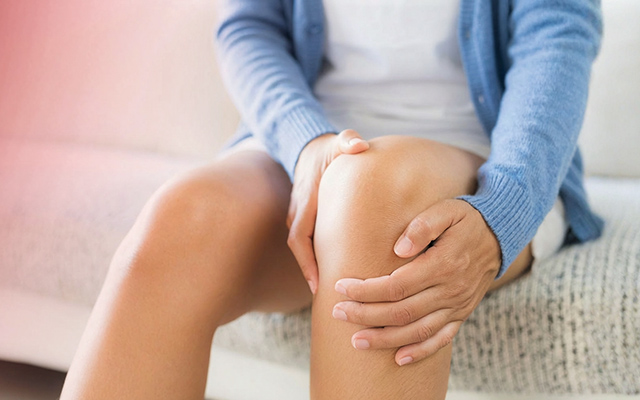
In many homes, knee pain doesn’t start as pain. It starts as an adjustment.
You hold the railing while climbing stairs. Avoid squatting. Sit down slowly and get up slowly.
You say in agony, “When will this discomfort end?”
Ayurveda does not treat this as ageing. It treats it as ‘progressive joint pathology’ that worsens silently when ignored.
What Ayurveda Actually Calls Chronic Knee Pain
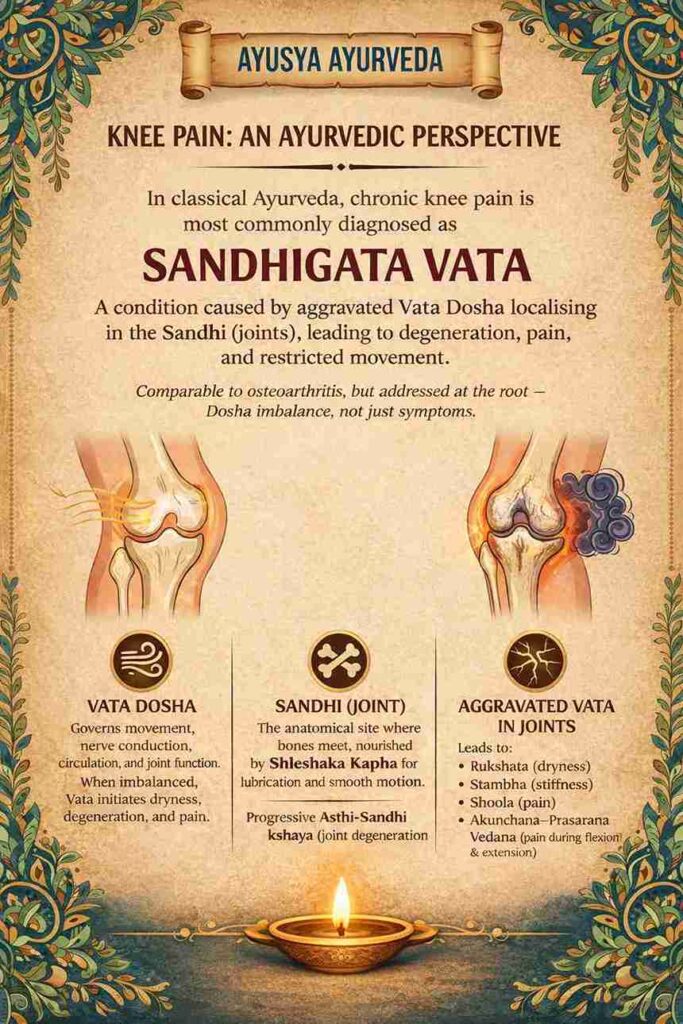
In classical Ayurveda, the most common form of knee pain is diagnosed as Sandhigata Vata.
What Sandhigata Vata means
- Sandhi – joint
- Gata – lodged inside
- Vata – the dosha responsible for movement, dryness, degeneration
When aggravated Vata dosha lodges in the knee joint, it leads to:
- Loss of lubrication
- Degeneration of cartilage
- Pain during movement
- Stiffness after rest
- Crackling or grinding sounds
This condition is frequently associated with:
- Asthi Kshaya (bone tissue depletion)
- Majja Kshaya (marrow and nerve support depletion)
At our Ayurvedic clinic in Kolkata (& Howrah), we begin knee pain treatment by identifying which of these processes is active, rather than masking pain.
Ayurvedic Causes of Knee Pain (Samprapti Explained Simply)
Ayurveda explains disease through Samprapti, the step-by-step process of disease formation.
The real chain behind knee pain
- Mandagni – weak digestive fire
- Formation of Ama – sticky metabolic toxins
- Ama blocks Srotas (nutrient channels)
- Poor nourishment of Asthi Dhatu (bone tissue)
- Aggravation of Vata dosha
- Vata lodges in the knee joint
- Degeneration, pain, and stiffness begin
Winter Worsens Knee Pain because:
- Sheeta (cold), Ruksha (dry), and Chala (instability) qualities increase Vata
- Damp climate promotes channel blockage and affects circulation
- Reduced movement increases joint stiffness.
That is why our Ayurvedic knee pain treatment addresses digestion, dosha balance, and joint nourishment together—not just the joint.
Different Ayurvedic Patterns of Knee Pain
Not all knee pain is the same. At Ayusya Ayurveda, an ayurvedic clinic in Kolkata (& Howrah), cases are classified clearly.
Sandhigata Vata (Degenerative pain)
- Dryness
- Pain on movement
- Sound in the joint
- Worse in cold weather
Ama-janya Sandhi Shoola (Inflammatory pain)
- Swelling
- Heaviness
- Pain even at rest
- Associated with indigestion, bloating
Vata–Kapha Avarana
- Stiff, heavy knee
- Limited movement
- Pain with swelling
Correct identification decides treatment. Guesswork fails.
Why Painkillers and Injections Don’t Solve the Problem
Painkillers reduce sensation. But, they do not:
- Improve digestion
- Nourish bone tissue
- Restore lubrication
- Correct Vata imbalance
Injections may temporarily reduce inflammation, but do not stop degeneration.
That is why patients searching for ayurvedic knee pain relief without surgery often turn to Ayusya Ayurveda after repeated failures.
Our (Actual Chikitsa) to Treat Knee Pain
Ayusya follows stage-wise Ayurvedic chikitsa, not one-size solutions.
Shamana Chikitsa (Internal treatment)
Used in early to moderate stages of knee pain. The primary focus is to correct the internal imbalance that triggers joint degeneration:
- Pacify aggravated Vata dosha, which causes dryness, pain, and degeneration
- Digest Ama (metabolic toxins) that block nourishment to the joint
- Nourish Asthi and Majja Dhatu to support bone and joint strength
This phase includes ayurvedic knee pain treatment using internal herbal formulations selected only after proper assessment of digestion, constitution, and disease stage.
At our ayurvedic clinic in Kolkata, the aim is to stop progression before structural damage sets in.
Panchakarma-Based Therapies for Knee Pain
When knee pain becomes chronic, stiffness dominates daily movement, or degeneration progresses despite medications, Ayurveda shifts from internal correction alone to Panchakarma-based intervention.
At this stage, the problem is no longer superficial. Vata dosha is deeply lodged in the joints, and toxins (Ama) obstruct proper nourishment.
Panchakarma works by removing obstruction, pacifying aggravated doshas, and restoring tissue function, rather than merely reducing pain.
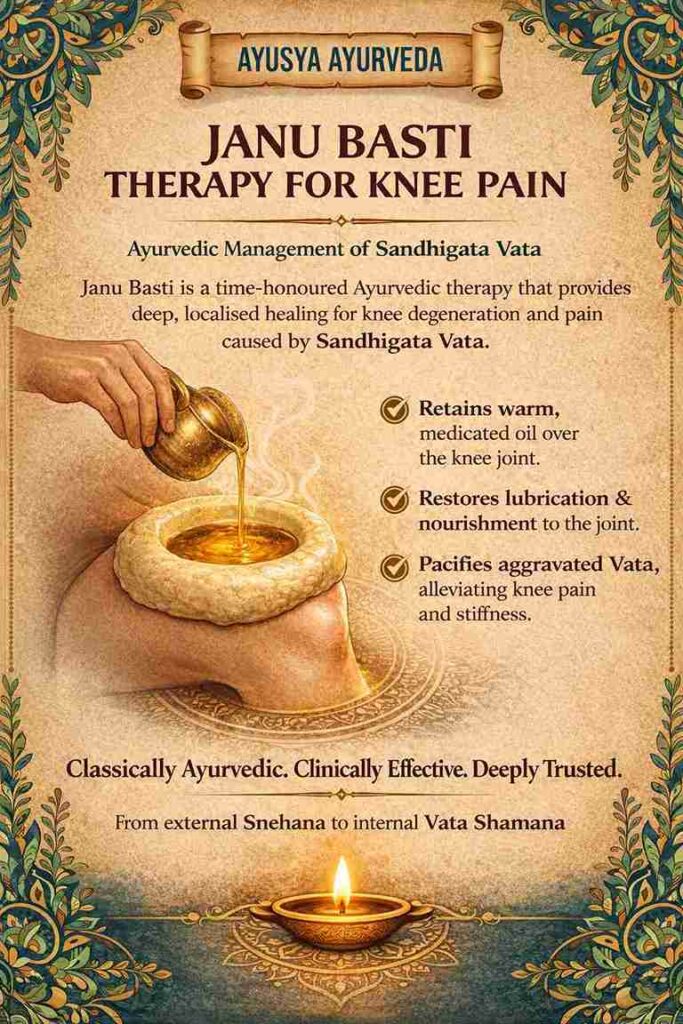
Janu Basti Therapy for Knee Pain
Janu Basti is a classical, localised Panchakarma therapy in which warm, medicated oil is retained over the knee joint for a fixed duration. The sustained warmth and oleation allow the medicine to penetrate deeply into the joint space.
This therapy helps by:
- Providing deep lubrication to joint tissues, countering dryness caused by Vata
- Reducing stiffness, rigidity, and pain that worsen with cold and inactivity
- Improving local circulation, enabling better delivery of nourishment to Asthi and Majja Dhatu
- Supporting gradual healing without trauma, force, or sudden stress on the joint
Janu Basti addresses tissue degeneration; it remains a cornerstone of Ayurvedic knee pain treatment for patients in Kolkata, especially during the winter months.
Supportive Panchakarma Procedures
Janu Basti is often supported by:
- Abhyanga (medicated oil massage) to pacify systemic Vata and prepare tissues
- Swedana (therapeutic sudation) to open blocked channels and ease movement
Let’s further Elaborate
Abhyanga (Medicated Oil Massage)
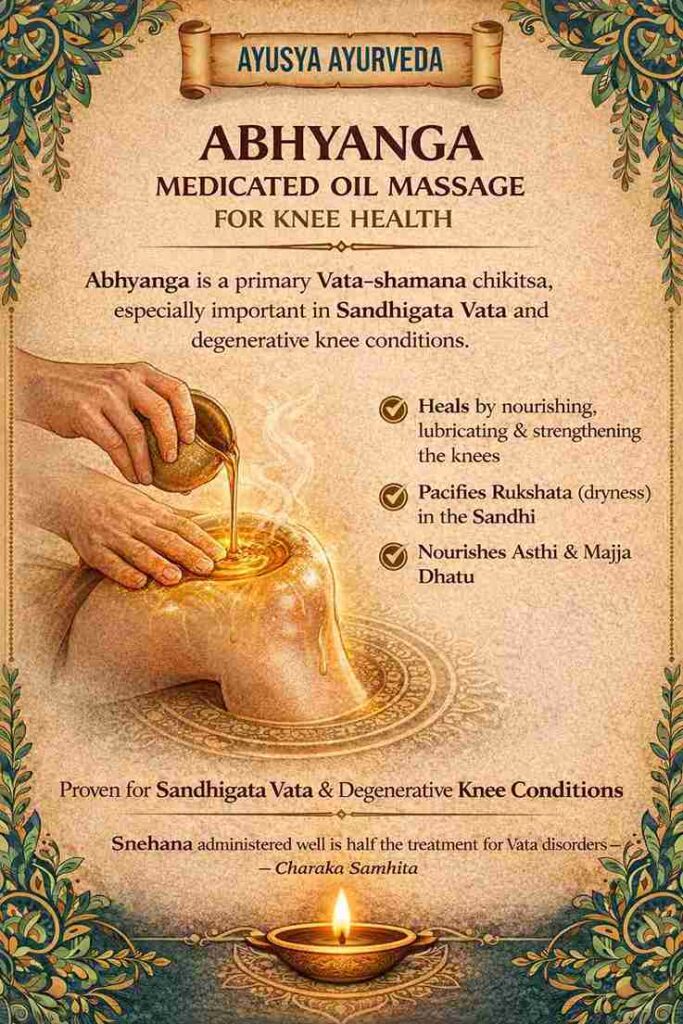
Abhyanga is a primary Vata-shamana chikitsa, especially important in Sandhigata Vata and degenerative knee conditions.
- Pacifies Chala and Ruksha guna of aggravated Vata, the root cause of joint pain and dryness
- Medicated oils penetrate the skin and act on Twak, Mamsa, Asthi and Majja Dhatu.
- Improves Rakta and Rasa circulation, ensuring proper nourishment reaches the knee joint
- Reduces Khara (roughness) and Stambha (stiffness) in peri-articular tissues
- Strengthens ligaments and surrounding muscles supporting the knee
- Prepares the joint for deeper therapies like Janu Basti by softening tissues
- Enhances response to internal Shamana aushadhi by clearing local obstruction
Swedana: The Science of Therapeutic Heat For Srotoshodhana
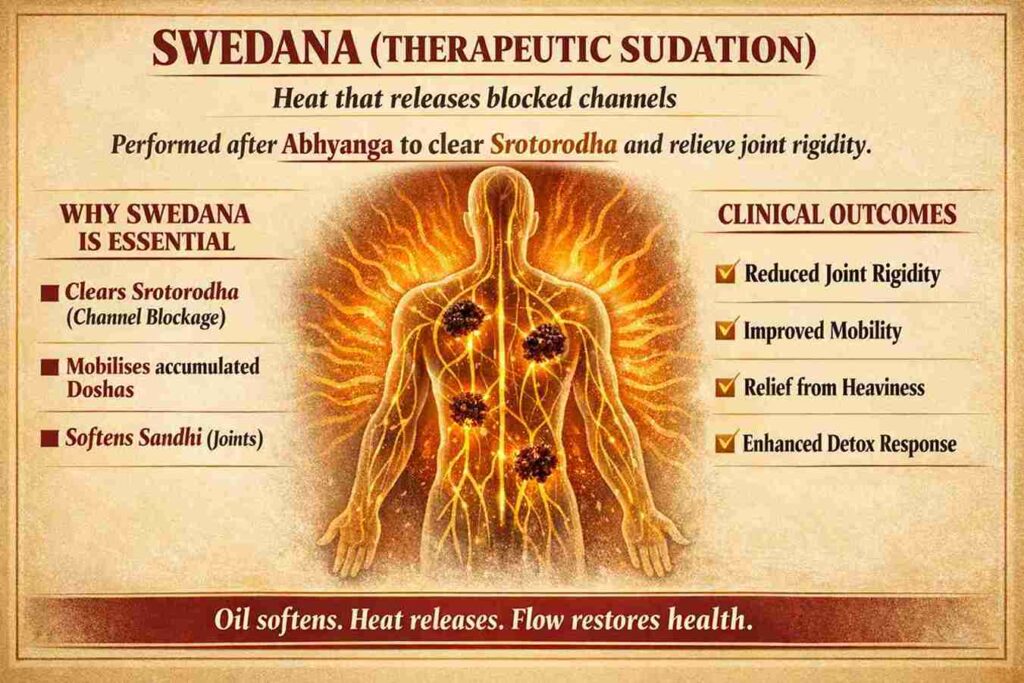
Swedana is used after Abhyanga to address Srotorodha (channel blockage) and joint rigidity.
- Relieves Stambha (stiffness), Gaurava (heaviness) and Shoola (pain) in the knee
- Opens obstructed Srotas, allowing trapped Ama to loosen and mobilise
- Pacifies Vata–Kapha avarana, a common cause of swollen, stiff knees
- Improves joint flexibility by reducing Sheeta guna aggravated during winter
- Enhances absorption and action of medicated oils applied during Abhyanga
- Supports local detoxification and improves ease of movement
- Makes the knee receptive to further Panchakarma and Rasayana support
Rasayana Therapy (Rebuilding Phase)
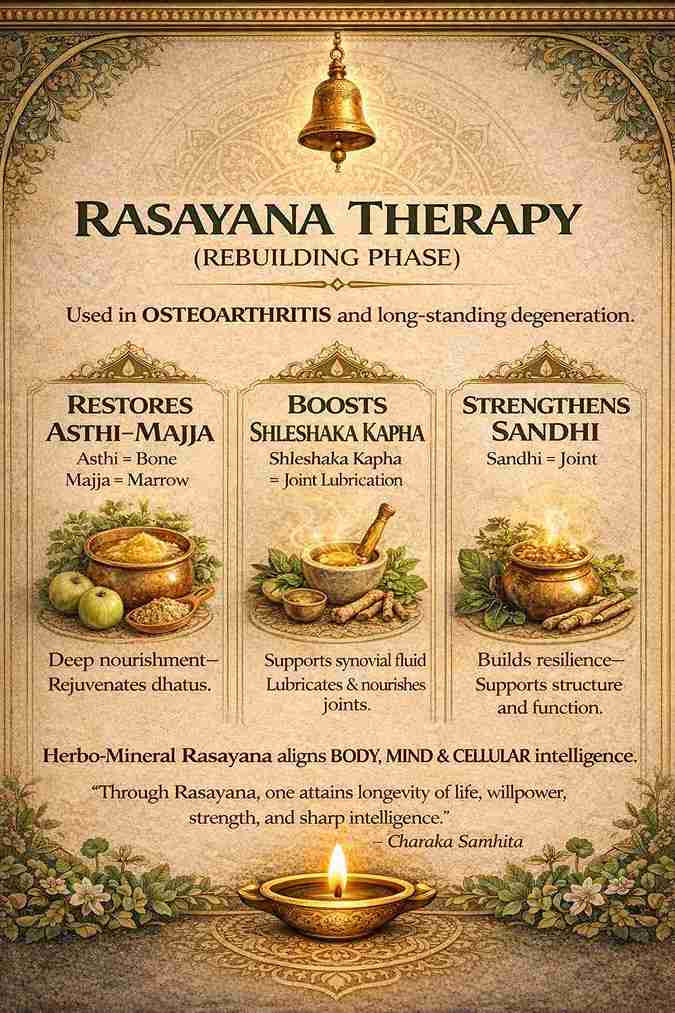
Used in osteoarthritis and long-standing degeneration.
Goal:
- Strengthen Asthi Dhatu
- Slow cartilage wear
- Improve joint stability
This includes herbal medicines for osteoarthritis knee ayurvedic care relies on.
Stage-wise Ayurvedic Knee Pain Treatment
| Knee Pain Stage | Ayurvedic Approach |
| Early stiffness | Shamana Chikitsa + diet correction |
| Moderate pain | Janu Basti + internal medicines |
| Osteoarthritis | Rasayana + Panchakarma |
| Surgery advised | Ayurvedic second opinion |
This structured approach is why people in India trust natural remedies for knee joint pain, rooted in Ayurveda.
Can Ayurveda Help Avoid Knee Surgery?
Many ask how to avoid knee surgery joint pain ayurveda discusses.
Honest answer:
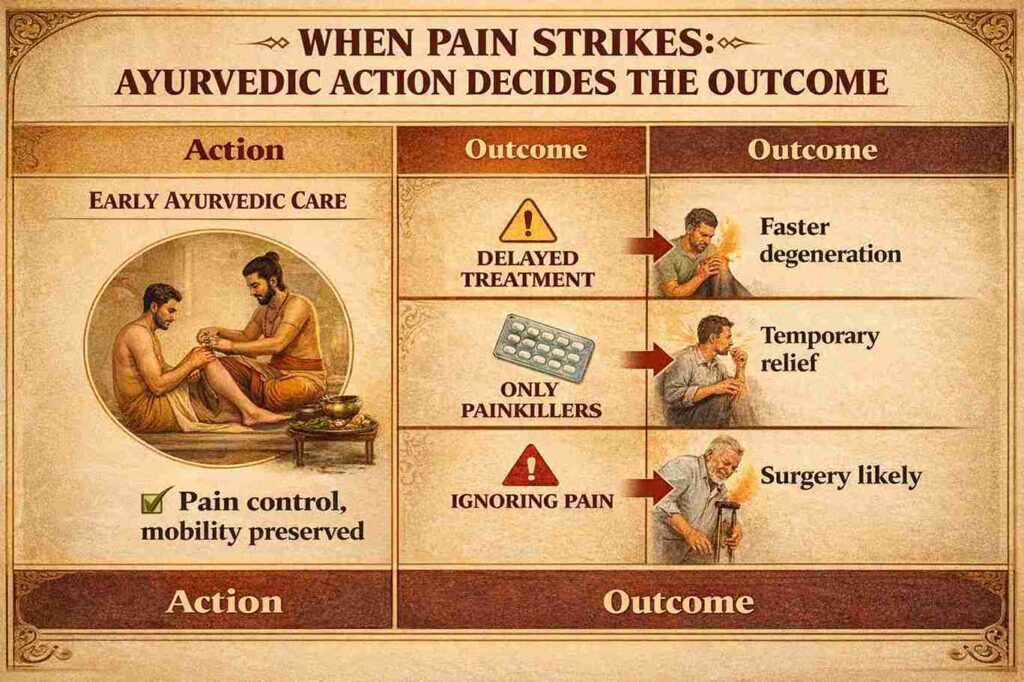
- Early and moderate cases respond well
- Advanced degeneration may still need surgery
- Ayurveda can delay or reduce severity
Ayurveda works best before cartilage collapse.
Supportive Care That Makes Treatment Effective
Ayurvedic home remedies for knee arthritis (supportive only)
- Warm oil application
- Avoid cold exposure
- Gentle daily movement
They support therapy but cannot replace it.
How to treat meniscus injury naturally: Ayurveda explains
Mild meniscus injuries improve when:
- Inflammation reduces
- Vata is pacified
- Movement patterns are corrected
Early Care vs Delay
Diet and Lifestyle Matter More Than You Think
Ayurvedic knee pain management through diet and yoga insists on:
- Warm, unctuous (or oily) food
- Avoid dry, cold meals
- No prolonged sitting
- Gentle strengthening exercises
When digestion is strong, nourishment reaches the joints. And when food and habits are wrong, joints dry out and pain increases.
Simply put, food either feeds the joint or dries it further.
A Truth Everyone Must Hear

At our multi-speciality ayurvedic clinic in Kolkata (& Howrah), we exist not to replace surgery blindly, but to prevent unnecessary progression.
Simply put, our ayurvedic knee pain treatment treats knee pain as a systemic disorder, not a local complaint.
Don’t Ignore Your Knee Again
Choose understanding. Joints that last. And early ayurvedic knee pain treatment at Ayusya Ayurveda, your go-to ayurvedic clinic in Kolkata.
Book a consultation!
People Also Ask
Why does knee pain feel worse at night even if I don’t walk much?
As joints cool down at night, circulation slows, and stiffness becomes more noticeable when movement reduces.
Can long-term knee pain affect other body parts?
Yes. It often changes posture and walking style, leading to back pain, hip strain, or ankle issues over time.
Is the cracking sound in the knee always serious?
Not always. But when cracking is accompanied by pain, stiffness, or swelling, it signals a joint imbalance that warrants evaluation.
Does body weight directly impact knee pain?
Yes. Even small weight gain increases pressure on knee joints, accelerating wear and discomfort.
When should knee pain never be ignored?
If pain affects sleep, daily movement, or confidence while walking, it’s time to seek guidance immediately.